Wednesday, December 8, 2010

Internet Marketing

Internet marketing:-
It is using the Internet to do one or more of the following:
  • Communicate a company's message about itself, its products, or its services.
  • Conduct research as to the nature (demographics, preferences, and needs) of existing and potential customers.
  • Sell goods, services, or advertising space over the Internet
The definition of Internet marketing may vary depending on who is using the term. For example, someone who had a home business in which they made money online selling something, might refer to their home business as an Internet marketing business. It would not be inaccurate to do so.
If someone has a website and wants to drive more traffic to it, they might employ what they refer to as Internet marketing techniques - such as writing articles, blogging, placing banner ads on other websites, etc. - to accomplish that goal.
When used in reference to a collection of marketing techniques, the definition of Internet marketing is broader than search marketing, because the latter involves employing techniques primarily aimed at getting listed on search results pages - either through paid advertising, like PPC, or through organic search engine optimization (SEO). When referring to online marketing techniques, Internet marketing might include placing videos on YouTube as an Internet viral marketing tool and generating buzz, or placing banner or text ads on other sites. In this case, the Internet marketing techniques are not primarily aimed at search engines (although it can be an indirect benefit).
So, in short, Internet marketing is the process of marketing goods or services through the Internet - both for those whose income is derived solely from the Internet - and for those who have a brick and mortar location but choose to advertise on the Web.
Also Known As: online marketing, web marketing, website promotion, online business, Internet business
 
Examples:
 
Internet marketing can be used to increase the sales of a business, make the business more widely known to its potential customers, or as a way of doing business, which is whey the definition of Internet marketing may seem a bit confusing

Sunday, December 5, 2010

Marketing Myopia

Marketing myopia is unnecessarily common among business people. It is not seeing 'down the road'. Many business people make their decisions based on current circumstances. They do not think about what will likely occur in their industry in the future. One reason that short sightedness is so common is that people feel that they can not accurately predict the future. They are right, of course. But just because we cannot accurately predict the future, that is no reason why we should not use the whole range of business prediction techniques available to us to estimate future circumstances as best we can.
 
Marketing Myopia is the failure to define an organization's purpose in terms of its function from the consumers' point of view. For example, railway companies that define their markets in terms of trains, rather than transportation, fail to recognize the challenge of competition from cars, airlines, and buses. It is therefore necessary to define the needs of the consumer in more general terms rather than product-specific terms. Marketing Myopia is the short sighted look of the managers in wrongly identifying the category and goals of the company, not looking at the whole industry of the product neglecting the fields of opportunities in their area of industry, not listening to the customer's real n

The Marketing Process Company

The Marketing Process Company is a management consulting company specialising in marketing strategy development and business process change. The Marketing Process Company's consultants have assisted a wide range of client firms around the world in becoming market-led, customer-driven organisations.
The company aims to deliver enhanced business profitability through improved marketing strategy and marketing plan development. The company's processes, systems and software are robust, tried and tested in the real world, delivering real and ongoing benefits to clients.

Marketing Planning

The Marketing Process Company has a full suite of consulting offers and marketing software. From initial market mapping, through market segmentation to the delivery of marketing plans, the company can assist clients in improving all aspects of their strategic marketing planning.

Key Account Management

Understanding the nature of the different relationships between a business and its customers and developing appropriate strategies is vital. The Marketing Process Company has developped a unique software tool for Key Account selection; this tool and supporting consultancy enables effective management of the 20% of a business's clients that typically contribute to 80% of its profits

Market Definition

In marketing, the term market refers to the group of consumers or organizations that is interested in the product, has the resources to purchase the product, and is permitted by law and other regulations to acquire the product. The market definition begins with the total population and progressively narrows as shown in the following diagram.
Market Definition
Conceptual Diagram


Beginning with the total population, various terms are used to describe the market based on the level of narrowing:

Total populationPotential market - those in the total population who have interest in acquiring the product.
Available market - those in the potential market who have enough money to buy the product.
Qualified available market - those in the available market who legally are permitted to buy the product.
Target market - the segment of the qualified available market that the firm has decided to serve (the served market).
Penetrated market - those in the target market who have purchased the product.
In the above listing, "product" refers to both physical products and services.
The size of the market is not necessarily fixed. For example, the size of the available market for a product can be increased by decreasing the product's price, and the size of the qualified available market can be increased through changes in legislation that result in fewer restrictions on who can buy the product.
Defining the market is the first step in analyzing it. Since the market is likely to be composed of consumers whose needs differ, market segmentation is useful in order to better understand those needs and to select the groups within the market that the firm will serve

MARKETING IS NOT SELLING

MARKETING IS NOT SELLING
 Develop a Market Plan for Yourself and Your Business?

1. Marketing - is the process by which a product or service originates and is then priced, promoted, and distributed to consumers. In many large corporations the principal marketing functions precede the manufacture of the product or service. In the case of a product they involve market research and product development, design and testing.

2. Marketing - includes planning, organizing, directing and controlling the decision-making regarding product lines, services, pricing, promotion and servicing of the product.

3. Marketing - is the process that brings ideas, goods and or services to the marketplace through planning, pricing, coordinating, promoting, selling and distribution. It includes all the activities involved in the transfer of goods or services from the producer or seller to the consumer or buyer.
.
When we get down to the basics the purpose of marketing is to identify potential customers for your products and services in enough numbers, in a sustainable way, so you can make your business successful and profitable for the long term. A well thought out marketing plan is a key investment in your future business. No matter how good your products or services may be, you still have to practice careful and planned marketing to avoid problems along the way. Slow sales growth or slumping sales and gross profit are marketing problems. Loss of market share is a marketing problem. Not having a defined targeted market direction is a marketing problem and not knowing how you are going to get your product or service to the marketplace is a marketing problem. Where marketing once stopped with the sale, today businesses believe that it is easier and more profitable to sell to existing customers than to new one. As a result, marketing now also involves finding ways to turn one-time purchasers into lifelong customers.

Keep in mind that the marketing planning process defines the strategic direction of your company. The sales plan and strategy is just one part of the marketing plan. You develop the marketing plan first then the sales plan. The marketing strategy (or plan) defines the process by which a business decides what products(s) or service(s) it will sell, to whom, when and how. For any plan to be successful, the mix of the four “Ps” must reflect the wants and desires of the consumers in the targeted market. Successful marketing depends on marketing research, both formal and informal, to determine what consumers want and what they are willing to pay for.

The four Ps are:
·         Product: The product management and marketing deals with the specifications of the actual good or service and how it relates to the end-user’s needs and wants.
·         Pricing: This refers to the process of setting a price for the product based on value to the end user and what the market for that product will bear.
·         Promotion: This includes advertising, sales promotion, publicity and personal selling and refers to the various ways of promoting the product, the brand and/or the company.
·         Placement or distribution: Refers to how the product gets to the customers. Where is it sold, in what market area or industry and to whom?

Walk with me through the following process and questions. The input will act as the foundation in developing the marketing plan. Keep in mind that the most important driver of the marketing plan is the ultimate “return on your investment, both time and money”.

1. What business are you in?
If Southern Pacific railroad had known that they were in the “transportation business” and not the “railroad business” there would probably be Southern Pacific Airlines or Southern Pacific Cruise Lines by now. Instead they are out of business.
·         Know what product or service you will provide and what its’ benefits are to the end user.
·         What does success in that business look like to you?
·         What would success look like to your customer or client using you product or service?
·         What do you want to be doing each day, and how will you know you are satisfying your customers or clients?
·         What is the vision and mission statement of your company? When you decide, write them both down, frame them and look at them daily. It will ultimately be your directive and hopefully you’re operating culture. Share it on a constant basis will everyone in your organization.

2. What are your products or services? Describe them in writing.
·         How is what you or your products do unique versus what other companies do?
·         What benefits and/or value does your product or service provide to the customer or client?
·         What makes you uniquely qualified to provide these products or service to the intended customer/client?
·         Tie your product or service to a “return on investment” for the customer/client.

3. Based on the above, prepare a 15-second “elevator speech” to explain what your company does and what benefits it provides the customer/client.
The objective of your “elevator speech” should be to gain enough interest that it results in a subsequent meeting with the potential client so they can learn more about your product(s) or service(s). It is important that you are able to articulate what your company does so that the potential client understands what your service can mean to them. What is it that you can say that will want them to find out more?


4. Who is the target audience for your product and/or service?
Once you determine where you want to sell your products and services you will direct everything you do to that particular market segment or segments. Tie the benefits you provide to the needs of your customer.

5. Develop a marketing plan.
The market plan will further focus you on the marketing issues: defining the products and services, who your target markets are, who is your competition as well as the direction you want to go and the daily methodology you will need to get there. Market plans are developed for different reasons, i.e. to borrow for the business but also to create a roadmap for running your business, this article addresses the latter.

Determine what your SWOT is, i.e. your strengths, your weaknesses, your opportunities and your threats. You should also do a SWOT analysis on your competition so that you know where and how to target your strategies. Always look for a competitive advantage.

Operating your company without a marketing plan is like building a house without a blueprint, or driving to a specific place in California without a map. If you don’t know where you’re going any road will get you there, but you may not like the place when you arrive, assuming you arrive at your desired destination at all.

6. Develop effective marketing tools and activities.
Remember that marketing is not selling. Marketing is the act of creating a need among potential customers for the goods and services you offer. The difference between what a customer thinks he wants and what they really need is the value you provide. You must drive the customer to come to you because they feel you will be able to fill both their stated and unstated needs. If you market well, you don’t have to sell.

The key to successful marketing is to develop the plan and then consistently work that plan.
Like it or not, we are in the marketing business as well as the selling of goods and services. Establish appropriate marketing tools to fit the market or markets you are targeting (Find a good graphic designer as well as a good printer).
·         Business cards – Your business card should give the potential customer/client enough information so that they know what you do and how to get in touch with your. The card should be elegant in its simplicity.
·         Stationary, second sheets, envelopes and address labels should all be the same stock, color and texture and consistent with your name, address and logo. You can buy custom designed labels which can be used for larger envelopes and packages.
·         Create a client presentation kit, using a professional looking folder. You can have your logo and name on it, but keep it simple and elegant. It should have two pockets and usually a die-cut for your business card.
·         Testimonials – Potential customer want to know that you are capable of accomplishing what you say you will do. Even if just starting out you should be able to develop a handful of satisfied clients. Ask them to state the value they experienced as a result of doing business with you.
·         Give workshops, seminars and speeches. In the area of services, whether it be business or legal, give talks and seminars. Join organizations, the more exposure you get the more you will be recognized as an authority in your field, whether it be in an industry or on a particular subject matter.
·         Write articles and white papers – Write on issues in which your are proficient, Send them out to known business contacts, newsletters and publications. When you write on subjects you know about, you are considered knowledgeable on that particular subject.
·         Biographical sketch – If you are a consultant or lawyer etc performing services you should have a biographical sketch. This is not a resume and should not look like one. It should be a brief description of who you are and what you specialize in, as well as what you have accomplished and what is being said about you. You will add to this as you experience new successes.
·         Maximize your visibility – Try to contact everyone in your target market with constant communications on issues pertinent to their needs.
- Network by attending trade associations and getting on the board. Be a contributor to
   your Chamber of  Commerce meetings and business organizations, focus on the
   industries you want to service.
      - Make yourself known and available for interviews with industry magazines as well as
        radio and TV stations.
      - Develop “targeted” brochures as a “leave behind” that will discuss what services and
         results you provide. It’s a known fact that people you present to will forget 80% of
         what you talked about one hour after you leave. The brochure will serve as a reminder
         of your services, products and benefits long after you’ve gone..
- Publish and/or advertise in trade magazines, newspapers, as well Chamber of
  Commerce, association and corporate newsletters.

Most people don’t get this simple marketing truth: Marketing’s job is to facilitate the prospect’s decision-making process and cause them to say, “I would have to be a fool to do business with anyone but you…regardless of price”. People need to hear what they actually need to know: What makes you and your company special, what makes you different from the competition and why come to you instead of your competition. All of the above stated points will help you to differentiate you from the rest. You don’t have to sell anyone. Define yourself and your value and let them sell themselves.
                 ______________________________________________________________________

Jack Hoffmann is the President and founder of Milestone Solutions LLC, a consulting firm assisting companies of all sizes to maximize their business and people performance.. Jack serves on corporate and community Boards and is a frequent speaker at industry and company events.

Saturday, December 4, 2010

Marketing mix

DEFINATION:
Its a Combination of marketing elements used in the sale of a particular product.The tools available to a business to gain the reaction which it is seeking from its target market in relation to its marketing objectives.
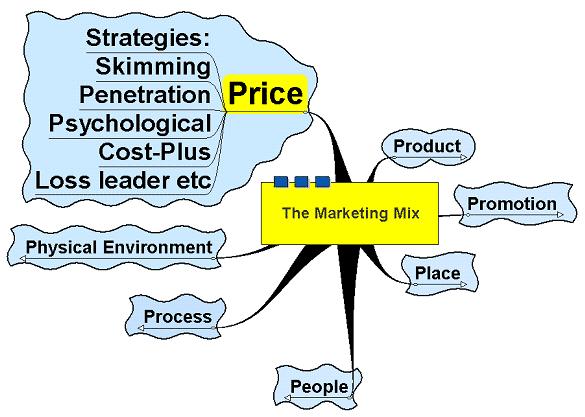
It consists of 7Ps – Price, Product, Promotion, Place, People, Process, Physical Environment.
Traditional 4Ps  are extended to encompass growth of service industry.
Pricing Strategies:
There are many ways to price a product. Let's have a look at some of them and try to understand the best policy/strategy in various situations. Premium pricing, penetration pricing, economy pricing, and price skimming are the four main pricing policies/strategies. They form the bases for the exercise. However there are other important approaches to pricing.
Price Skimming:
Charge a high price because you have a substantial competitive advantage. However, the advantage is not sustainable. The high price tends to attract new competitors into the market, and the price falls due to increased supply. Manufacturers of digital watches used a skimming approach in the 1970s. Once other manufacturers were tempted into the market and the watches were produced at a lower unit cost and other marketing strategies and pricing approaches are implemented. E.g. mobilink
Penetration Pricing:
The price charged for products and services is set artificially low in order to gain market share. Once this is achieved, the price is increased. This approach was used by France Telecom and Sky TV. E.g. telenor
Psychological Pricing:
This approach is used when the marketer wants the consumer to respond on an emotional, rather than rational basis. For example 'price point perspective' 99 cents not one dollar.
 Cost-plus pricing:
Cost-plus pricing is the simplest pricing method. The firm calculates the cost of producing the product and adds on a percentage (profit) to that price to give the selling price. This method although simple has two flaws; it takes no account of demand and there is no way of determining if potential customers will purchase the product at the calculated price.
Price = Cost of Production + Margin of Profit. 
Loss Leader: Basic Concept In the majority of cases, this pricing strategy is illegal under EU and US Competition rules. No market leader would wish to sell below cost unless this is part of its overall strategy. The idea of selling at a loss may appear to be in the public interest and therefore not often challenged. Only when the leader pushes up prices, it then becomes suspicious.
Product:
For many a product is simply the tangible, phsysical entity that they may be buying or selling. You buy a new car and that's the product - simple! Or maybe not. When you buy a car, is the product more complex than you first thought? In order to actively explore the nature of a product further, lets consider it as three different products - the CORE product, the ACTUAL product, and finally the AUGMENTED product.

The CORE product is NOT the tangible, physical product. You can't touch it. That's because the core product is the BENEFIT of the product that makes it valuable to you. So with the car example, the benefit is convenience i.e. the ease at which you can go where you like, when you want to. Another core benefit is speed since you can travel around relatively quickly.
The ACTUAL product is the tangible, physical product. You can get some use out of it. Again with the car example, it is the vehicle that you test drive, buy and then collect.

The AUGMENTED product is the non-physical part of the product. It usually consists of lots of added value, for which you may or may not pay a premium. So when you buy a car, part of the augmented product would be the warranty, the customer service support offered by the car's manufacture, and any after-sales service.

Extension Strategies
Businesses will attempt to use extension strategies to prevent their product from going into decline. They will have to spend money in research and development to try and retain periods of growth and maturity for as long as possible in order to maximise sales.

Specialized versions:
For example Suzuki baleno sports.
New editions:
For example new editions of different softwares like antivirus , etc.
Changed packaging:
For example Pepsi

Promotion:
It is the communication link between sellers and buyers for the purpose of influencing, informing or persuading a potential buyer's purchasing decision.
A successful product or service means nothing unless the benefit of such a service can be communicated clearly to the target market. An organisations promotional strategy can consist of:

Advertising: It is any non personal paid form of communication using any form of mass media.
Direct Mail: Is the sending of publicity material to a named person within an organisation. There has been a massive growth in direct mail campaigns.
Organisations can pay thousands of pounds for databases, which contain names and addresses of potential customers. 
Direct mail allows an organisation to use their resources more effectively by allowing them to send publicity material to a named person within their target segment. By personalising advertising, response rates increase thus increasing the chance of improving sales.
Special offers: Special offers are made for promotional purposes.e.g
—   percentage reductions of the travel price,
—   early booking discounts ,
—  reductions for elderly persons and families.
Endorsement: In promotion, endorsement consists of :
—  a written or spoken statement,
—  sometimes from a person figure,
—  sometimes from a private citizen, extolling the virtue of some product.
E.g:  Shahid Afridi in head n shoulders advertisment.
User trials: User trials are also used for promotion purposes. Setting up a user trial is primarily about creating an environment that enables the interaction between a product and a user.It may the consumer to check the product and its usability.
Direct mailing: Is the sending of publicity material to a named person within an organisation. There has been a massive growth in direct mail campaigns. Organisations can pay thousands of pounds for databases, which contain names and addresses of potential customers. 
Promotion Strategies make the consumer aware of the existence of a product or service NOT just advertising.
Placement:
Placement under marketing mix involves all company activities that make the product available to the targeted customer (Kotler and Armstrong, 2004). Based on various factors such as sales, communications and contractual considerations, various ways of making products available to customers can be used (Lazer, 1971). Companies such as Ford, Ferrari, Toyota, and Nissan use specific dealers to make their products available, whereas companies such as Nestle involve a whole chain of wholesaler retailers to reach its customers. On a general note, while planning placement strategy under marketing mix analysis, companies consider six different channel decisions including choosing between direct access to customers or involving middlemen, choosing single or multiple channels of distributions, the length of the distribution channel, the types of intermediaries, the numbers of distributors, and which intermediary to use based on the quality and reputation.

Retail: To sell in small quantities directly to consumers. Retailers will have a much stronger personal relationship with the consumer. The retailer will hold several other brands and products. A consumer will expect to be exposed to many products. Products and services are promoted and merchandised by the retailer. The retailer will give the final selling price to the product. Retailers often have a strong 'brand' themselves e.g. Ross and Wall-Mart in the USA.
Wholesale: They break down 'bulk' into smaller packages for resale by a retailer. They buy from producers and resell to retailers. They take ownership or 'title' to goods whereas agents do not. They provide storage facilities. For example, cheese manufacturers seldom wait for their product to mature. They sell on to a wholesaler that will store it and eventually resell to a retailer. Wholesalers offer reduce the physical contact cost between the producer and consumer e.g. customer service costs, or sales force costs. A wholesaler will often take on the some of the marketing responsibilities. Many produce their own brochures and use their own telesales operations.
Internet: The Internet has a geographically disperse market. The main benefit of the Internet is that niche products reach a wider audience. Use e-commerce technology (for payment, shopping software, etc).
Direct selling: Direct selling is a retail channel for the distribution of goods and services. It may be defined as marketing and selling products, direct to consumers away from a fixed retail location. The direct personal presentation, demonstration, and sale of products and services to consumers, usually in their homes or at their jobs.
Peer to peer: It is a technique of encouraging customers to promote the product to one     another. Multi-channel: Multi-channel marketing utilizes many different marketing channels to reach a customer. It helps in reaching customers by: direct mail,text messaging, web sites, e-mail, door to door campaigns, newspaper advertisements.
Mail order: The other way through which product can reach the consumer includes mail order. Mail order is a term which describes the buying of goods or services by mail delivery. The buyer places an order for the desired products with the merchant through some remote method such as through a telephone call or web site. Then, the products are delivered to the customer.
The 4 Cs: Many now dismiss the four Ps as being out of date and have developed the four Cs to replace that concept.
Place becomes Convenience.
Price becomes Cost to the user.
Promotion becomes Communication.
Product becomes Customer needs and wants.
The four C's reflect a more customer oriented marketing philosophy. They provide useful reminders that you need to focus entirely on the customer when deciding where to offer a service. 


Friday, December 3, 2010

MARKETING PLANNING FOR YOUR PRODUCTION

MARKETING PLANNING FOR YOUR PRODUCTION

-          The number one seller for any production is word of mouth from those that have seen the show.  With that in mind it is critical to pack in your audiences on opening weekend.  (Avoid invited dress rehearsals as it reduces the number of patrons at the opening.)  The entire opening weekend should be as full as possible.  If you are giving away incentives or comps it is important to concentrate them on the opening weekend.  Shows get “bounce” from the word of mouth.  Always make sure you have the names, addresses and email addresses of anyone attending your production including comp tickets.  You want to capture that information to offer them other shows in the future.

-          Try to set up a preview article in the Arizona Republic talking about the show.  PR pitches to newspapers in general are advantageous. Stories get picked up and it is free advertising.  It is best to use a qualified PR person in theatre who knows the papers and has a press release list they can distribute information out to those in the media. 

-          Get in all the newspaper and local magazine entertainment calendar listings.  Again, a qualified theatrical PR person knows all of those listings and can do this for you. 

-          -Contact Alliance for Audience – the non-profit service organization whose job is to raise the visibility of Arizona’s entire arts & cultural community.  Their main project is ShowUp.com, Arizona’s comprehensive calendar of theatre, music, dance, art, festivals & cultural attractions.  To post your event listing, send info to events@showup.com.  ShowUp.com also offers a Ticket Marketplace where you can sell last-minute discount tickets as well as take advantage of promotional opportunities on TV, social media and to their e-mail database.

-          Build an email list and prep an E-Blast to go out to your personal mailing list inviting friends, family, colleagues, co-workers, employees, friends of cast members, other actors, previous purchasers in the database etc to the show.  Inside the email you can include the link to buy tickets.  This list must be created by the organization.  ***You can’t buy email addresses or email to another organizations email list.  People don’t read email from sources unknown to them.  Frequently, they either opt out of getting all future email from that source or click delete without even reading the offer***  Create your own list.

-          Direct Mail Postcard. Postcards are inexpensive to produce and cheap to mail through a mail house.  You can also purchase a specific list of names to mail to.  There are many sources to purchase lists.  You can also trade lists with other theatre companies for direct mail whereas you can’t for email.  This expands the number of individuals that you can get directly in front of.

-          Schedule the reviewers to attend your show.  They won’t just come.  You have to call them all and get them scheduled to a performance.  In addition, you should have a media package prepared for them at the box office for when they arrive.  Reviewers are the Arizona Republic, KEZ Radio, KBAQ Radio, New Times, Midtown Messenger, ECHO Magazine to name a few.  A theatrical PR person can point you towards all of the reviewers.

-          Depending on your budget you can run adds in the News Paper, on the Radio, and on TV.  Newspapers are the Arizona Republic, Tribune, Midtown Messenger, New Times, Echo Magazine to name a few.  Radio Stations are KEZ, KJZZ, KTAR, KBAQ.  You can run a banner ad on the AZ Central website online with a link to your website or to buy tickets as well

-          You will want to have your own website set up.  Phoenix Theatre offers you a back end online ticketing option to your organizations website.  We don’t market your shows from our site as it leads to brand confusion.   Phoenix Theatre produces 12-16 productions annually in four venues as well as fundraising events all of which are listed on our website.  We host nine resident companies in three venues producing 27-35 shows annually.  If we listed all of these shows on our website your production would be lost in a sea of show listings.  By directing potential patrons to your organizations website allows you to control the content and the sales pitch.  If you need to set up a website you can do so for free in about 15 minutes by going to www.yola.com. (Phoenix Theatre can list your companies name on our website to link patrons to your company.  There is a fee our website company charges us to add links that will be passed on to you.) 

-          Insert program stuffers in other theatre’s playbills and offer to do the same for them.  You should do this with multiple theatre companies and start a few months out from your opening.

-          Drop flyers at local establishments like restaurants, coffee shops, check out counters at retail stores etc.

-          Reach out to senior centers and school groups with discounted tickets if they buy 10 or more seats.  You should start to do this six months out as schools and senior centers book activities well in advance and have to arrange for transportation.

-          Make Opening Night special.  Include festivities, pre and/or post show receptions, wine, cheese ect.  You can have an opening night party at a nearby establishment or a meet and greet with the actors after the show.

-          Lastly it is important to note the importance of audience retention.  This includes but is not limited to things like sending patrons notes thanking them for coming and inviting them back to see other shows, perhaps with a special offer.  Asking audience members to come back is critical.